

What is our Philosophy?
DER through Qollca’s native geometry
Qualify
Declared Epistemic Responsibility
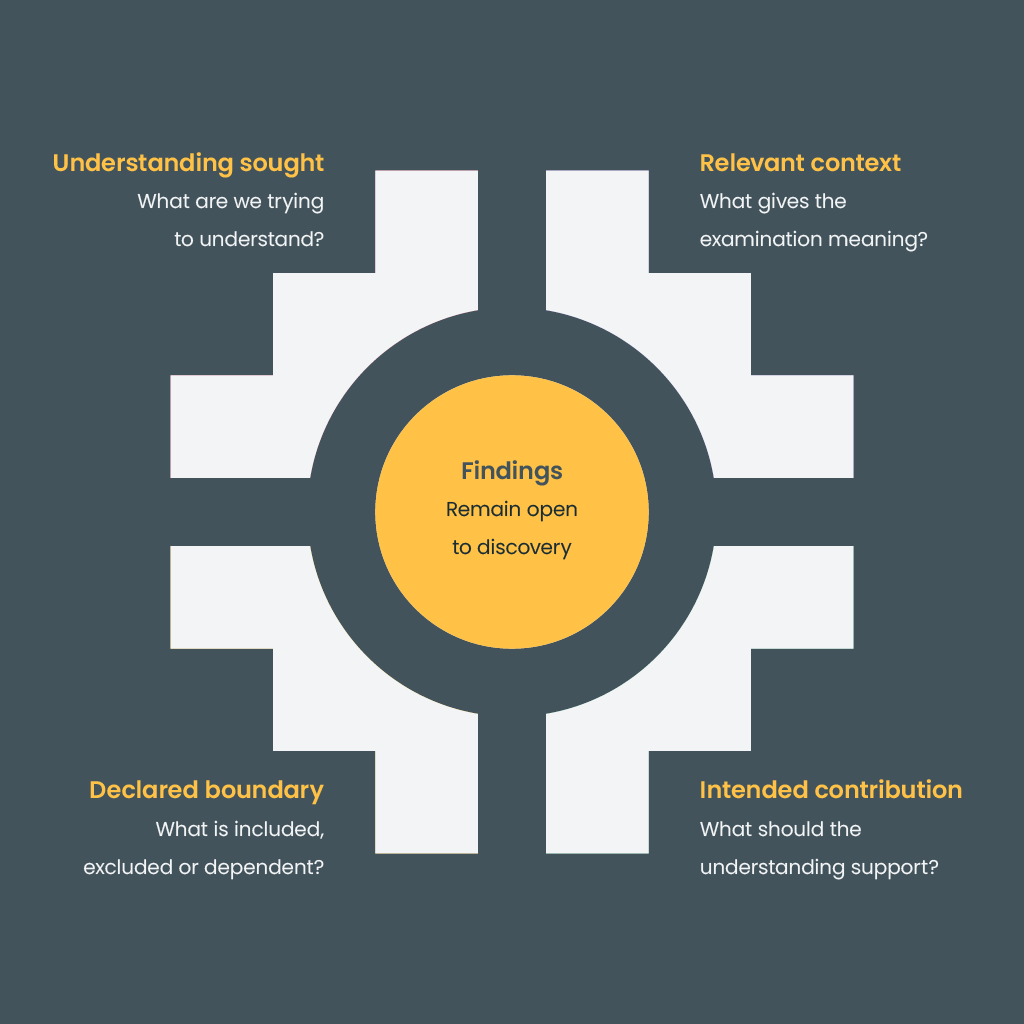
When we examine a situation, we need to be clear about what we undertake to understand, in what context, and within what limits.
Qollca calls this Declared Epistemic Responsibility (DER): making the undertaking explicit while leaving the findings open to discovery.
What DER Clarifies
These four aspects help make an examination’s undertaking clear, without deciding its findings in advance.
Understanding Sought
Make clear what the examination seeks to understand, rather than naming only the subject receiving attention.
Relevant Context
Identify the circumstances and assumptions that give the examination, and its eventual findings, their meaning.
Declared Boundary
State the limits of the examination’s undertaking, keeping material exclusions and dependencies visible.
Intended Contribution
Clarify what the resulting understanding is intended to support, without prescribing a finding or course of action.
DER in Practice
A team is repeatedly missing deadlines. Before choosing a fix, it clarifies what it needs to understand.
Define the Undertaking
The team undertakes to understand what contributes to missed deadlines in its current workflow.
The examination concerns recent projects and their dependencies, not individual performance ratings or justification for a preferred solution.
Weigh the Findings
The examination finds that work regularly waits for approval, while late handovers are less frequent.
Approval delays appear more significant, but the evidence does not yet establish whether capacity, priorities or unclear authority explain them.
Inform What Follows
Understanding the delays informs the next question: which change, if any, is justified?
That is a different undertaking, informed by the first examination’s findings and carrying forward their context and remaining uncertainty.
Quantify
Invariant Models
Qollca’s invariant models give its philosophy a practical structure for examining situations, developing understanding and supporting action.
Their defining relationships remain consistent, while their application can adapt to different contexts.
Qollca Action Sequence
The Qollca Action Sequence (QAS) distinguishes three actions through which understanding develops: Qualify, Quantify and Connect.
This is a logical progression, not a rigid one-pass process. New evidence or relationships may reopen earlier questions; connection builds on qualification and quantification rather than bypassing them.
Qualify — Establish the Context
Clarify what is being considered and under what conditions. Examine its identity, context, assumptions and boundaries so interpretation rests on more than an isolated observation.
Quantify — Assess the Significance
Consider its extent, value and consequence. This may involve numerical measurement, but also judgements of urgency, confidence or relative importance, keeping attention proportionate to what matters.
Connect — Relate and Apply
Relate the resulting understanding to people, contexts, dependencies, decisions and actions. Carry forward its meaning and limitations so it can contribute responsibly to what follows.
1+3 Architecture
The 1+3 architecture relates QAS — Qualify, Quantify and Connect — to one continuing governing reference.
The “1” remains present across the “3”, keeping activity coherent as understanding develops.
A Continuing Reference
The examination’s purpose, context and boundaries provide a shared point of reference.
This reference keeps the examination focused as activity changes, while leaving its findings open to discovery.
Distinct Action Responsibilities
Qualification, quantification and connection each contribute differently to the same examination.
Their relationship preserves the grounds on which understanding develops: significance depends on context, and responsible application depends on both.
Coherence Through Change
The “1” is not a first step, and the “3” are not compulsory stages.
Activity can recur, overlap or change direction while remaining accountable to the same undertaking, or making a revision to that undertaking explicit.
Qollca Thematic Classes
The Qollca Thematic Classes (QTC) distinguish four complementary perspectives through which a situation can be examined.
These are perspectives, not sequential stages. Each perspective brings different conditions and consequences into view.
The attention given to each depends on the situation, without treating one perspective as a complete account.
Behavioural — Internal Conditions
Consider the assumptions, motivations, capabilities and patterns shaping how an individual, group or system responds.
Examine how these internal conditions support, constrain or distort what is intended.
Relational — Wider Relationships
Consider the relationships, exchanges, dependencies and influences surrounding the subject.
Examine who or what is affected, and where a locally workable response may create consequences elsewhere.
Strategic — Intended Direction
Consider the direction being pursued and what it seeks to make possible.
Examine intended consequences and how present choices may influence future position.
Tactical — Practical Application
Consider how intent can be expressed in practice, given the evidence, resources and constraints available.
Examine what can be done and the practical consequences of doing it.
1+4 Architecture
The 1+4 architecture organises the QTC — Behavioural, Relational, Strategic and Tactical — around one Constitutional centre.
The “1” anchors the shared concern; the “4” examine it through different but related perspectives.
A Governing Centre
The centre establishes what is being examined, why it matters and the boundaries of the undertaking.
It provides a shared reference while leaving the findings open to discovery.
It is not a fifth perspective equivalent to the surrounding four.
Complementary Perspectives
Each perspective brings different conditions and consequences into view.
The same evidence can inform several perspectives, but insight from one cannot substitute for another where its questions are materially relevant.
Coordinated Inquiry
The perspectives remain related to the centre and to one another.
They need not receive equal attention or reach agreement; tensions and material omissions remain visible so the examination can develop without losing coherence.
Connect
Compounding Intellectual Surplus
Compounding Intellectual Surplus (CIS) occurs when understanding extends beyond its immediate use and strengthens the capacity to create, communicate or apply further understanding.
Its value is not simply what we retain, but what that understanding enables next.
Beyond First Use
Understanding can contribute beyond the question, decision or activity that first called for it.
The surplus lies in its continuing potential to inform later inquiry, judgement and action, not in accumulating more information.
Meaning Carried Forward
Understanding can travel through people, conversation, practice or records.
Its origin, context and limitations must remain sufficiently recoverable for later users to interpret what it means and whether it still applies.
Greater Future Capacity
Compounding occurs when earlier understanding strengthens the capacity to develop further understanding.
That contribution can improve the starting conditions of later inquiry, but repetition or reuse alone does not guarantee that improvement.